
here’s why they annoy you so much.
You can spot it from a mile away. It’s the poster jam-packed with shouty text, too much copy, unrealistic product images… In general it looks sort of like how a bad headache feels. Yes, it’s AI generated, and we’re becoming better and better at detecting it in just a glance. While the days of the model with two left hands may be gone – AI generated images have actually become much better – the rise of the AI graphics has hit like a landslide, and for many of us it’s just too much!
AI graphics have gone from novelty to everyday in record time, and if you’ve started scrolling past them with a small, involuntary sigh, you’re in good company. Merriam-Webster even named “slop” its word of the year for 2025, a nod to the tide of low-effort AI content clogging everyone’s feeds.
So what is it about AI-generated visuals that grates so much? And if you run a business, should you be using them at all? Let’s get into it.
what’s wrong with AI graphics?
Everything looks the same. AI image tools learn from millions of existing pictures, so they’re brilliant at producing the average of all of them. It’s not that any single graphic is terrible; it’s that you’ve seen it four hundred times this week.
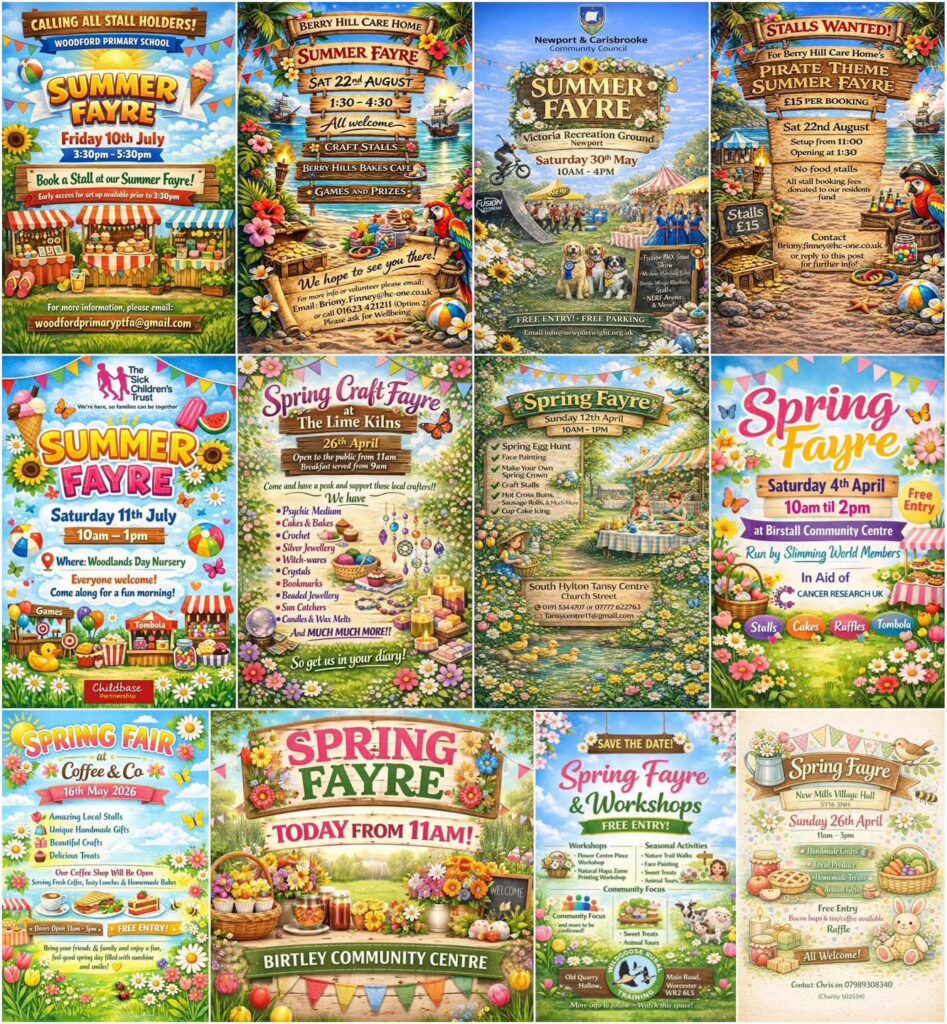
The above was collected by Barry Whitehouse, an artist and art tutor, you can find his original post here.
“A plea from an artist:
All these posters look the same, yet they are from different areas in the U.K. so much so I was concerned that I had repeated the same poster when compiling this.
I realise that many group committees are volunteers and people don’t have the time or funding to consult or even ask someone arty to make a poster for you, but please ditch the urge to ‘save time’ and money by using ChatGPT or other ai services.
At this point your poster would be better seen using Comic Sans and Word Art, or even a sharpie and a Helix letter stencil.
The excessive and sudden burst of ai to help ‘promote’ events has actually lead to nobody looking at the posters because when they appear on social media we think we’ve already seen it. It no longer works for marketing or promotional posters, as in its very brief appearance, ai has already saturated the market.
Please just get a marker pen out instead. Homemade and human made is the way forward now if you want your event to be seen and remembered.”
Everything clashes. AI graphics tend to keep everything on a single plain, use way too much copy and too many elements, wrestling in chaotic, busy images. There is no discipline in font choices, styles, colours, or positioning.
The tells give it away. Graphic quality keeps improving, but people still trust their gut. In a 2026 study by The Harris Poll UK, the biggest red flags were images that looked too perfect (51%), felt unrealistic (43%) or had small inconsistencies (42%). Think nonsense lettering on a shop sign, shadows pointing three ways at once, or a mug with two handles. Once you spot one, you can’t unsee it.
It doesn’t know your business. An AI tool has never met your customers, read your brand guidelines or held your product. So it guesses. That’s fine for a doodle; less fine when the “product shot” quietly invents a feature you don’t sell.
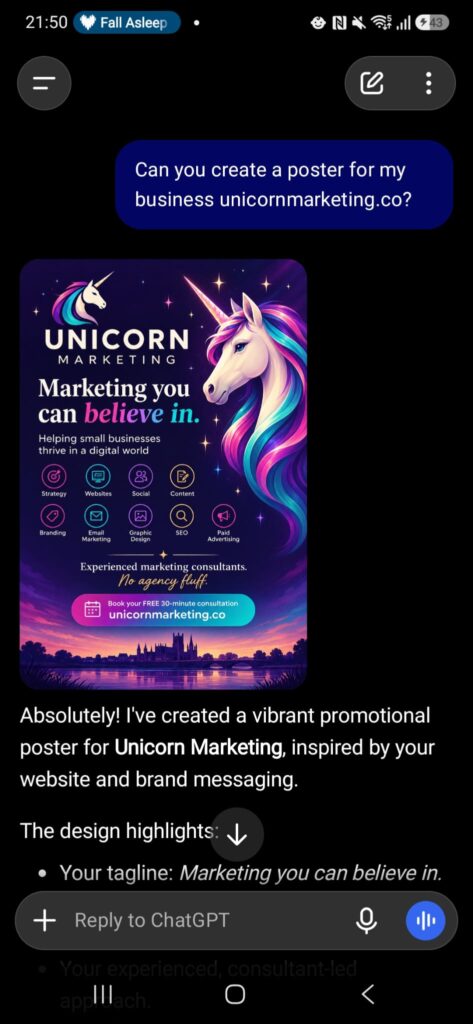
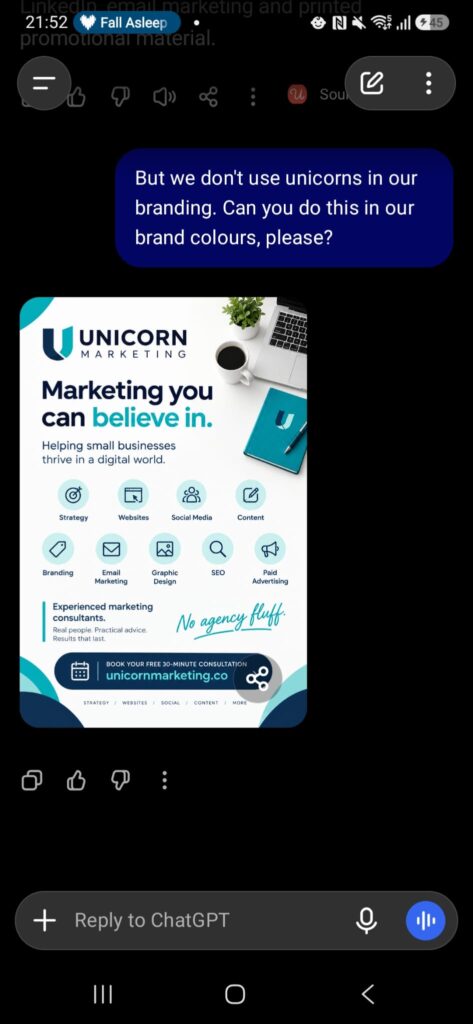
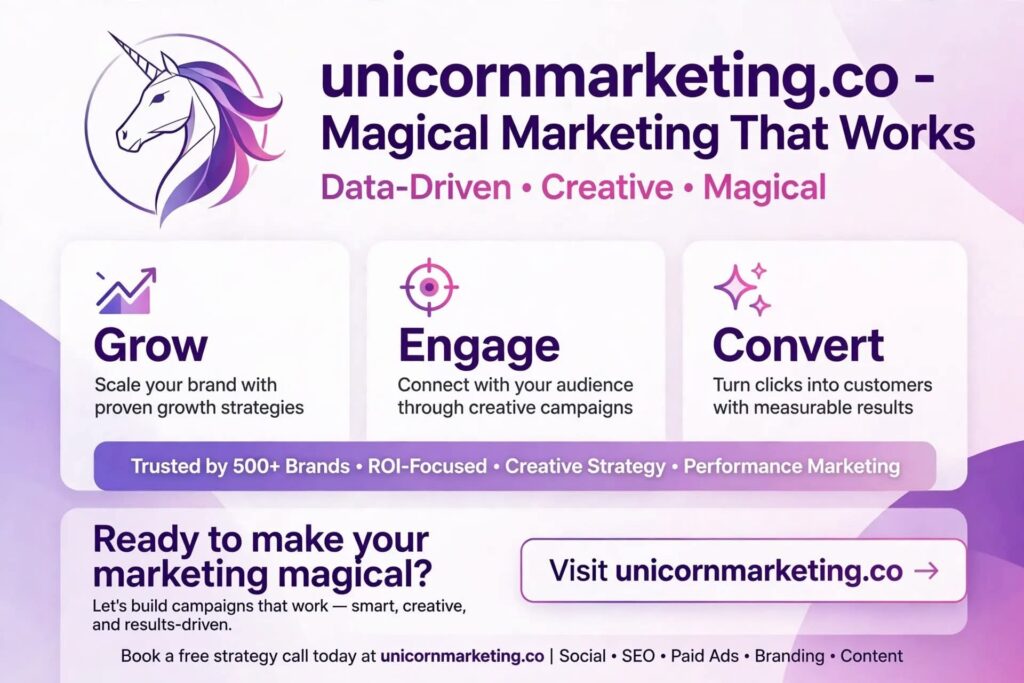
Here’s Meta AI completely ignoring our branding, and also making completely false claims out of nowhere (we most certainly do not work with 500+ brands!):
Even the giants have been burned. Valentino and McDonald’s both pulled AI-generated ads in late 2025 after audiences said they felt flat and out of touch, and Coca-Cola’s AI Christmas ad drew criticism for losing the warmth people expect from it. If budgets that size can’t make it land, the odds aren’t great for a quick prompt on a Tuesday afternoon.
the psychology of why AI graphics aren’t effective.
We read effort as care. Humans are wired to judge how much work went into something, and to treat that as a sign of how much the maker cares. The Harris Poll UK found two-thirds of people say AI-generated ads feel less authentic (66%) and suggest less effort (64%). The subtext your customer hears: if you couldn’t be bothered to make it, why should they bother to read it?
Trust drops off a cliff. In the same research, seven in ten consumers trust adverts made entirely by humans. That falls to four in ten when AI tools are involved, and to just two in ten when the ad is generated by AI alone.
“Too perfect” feels fake. Getty Images’ Jacqueline Bourke says people are now “hyper aware of images which look too polished or perfect”. Getty’s research across 25 countries found 98% of consumers see authentic imagery as essential to earning their trust, and 78% say an AI image can’t be considered authentic at all. As Harris Poll UK puts it, “perfection can work against credibility”.
Suspicion is the real killer. Here’s the twist: people aren’t great at spotting AI, and a Nielsen Norman Group test found unlabelled AI images didn’t dent trust in a website. But Getty’s testing showed acceptance of an image dropped as soon as people learned it was AI-made. And with everyone now primed to look for it, suspicion has become the default setting.
The industry hasn’t caught up. IAB research from early 2026 found 82% of ad executives think Gen Z and Millennials feel positive about AI ads. Only 45% actually do, and that gap is widening.
why human design is always better – even if it’s basic.
Yes, a team of human marketers is telling you human design is better. We’re aware of how that sounds. But the research is firmly on our side, and here’s why.
Specific beats generic. A designer starts with your audience, your product and your brand, not an average of everyone else’s. The result looks like you, which is rather the point of having a brand.
A bit of imperfection is honest. Getty’s research found people want imagery that feels real and a little imperfect. A clean graphic in your brand colours, a real photo of your actual team, or a bold typographic quote will out-trust a glossy hallucination every time. Basic, done with intent, wins.
It’s accurate. No invented product features, no gibberish text, no extra limbs to explain in the comments.
It’s consistent. Human-designed assets hang together across your website, social, emails and print, so every touchpoint builds recognition rather than resetting it.
It shows you care. Remember the effort effect? When customers can see real craft behind your marketing, they assume the same care goes into your product or service.
And I know there will be those small, independent micro businesses out there who are excitedly using and defending their AI graphics ‘we couldn’t possibly make or afford human graphic design to this degree – why aren’t you supporting us?!’. I get it, trust me I do. But I’m sorry to say that when I see these AI generated graphics, I switch off. I understand to you that it’s a revolution in your ability to market your business, but to me (and many others) I would much rather see a basic, real attempt from you as a human which shows me ‘hey, I’m a small business, I’ve done my best and hope you’ll support me’ over a visual that makes me feel so uneasy.
so, let’s perform an experiment…
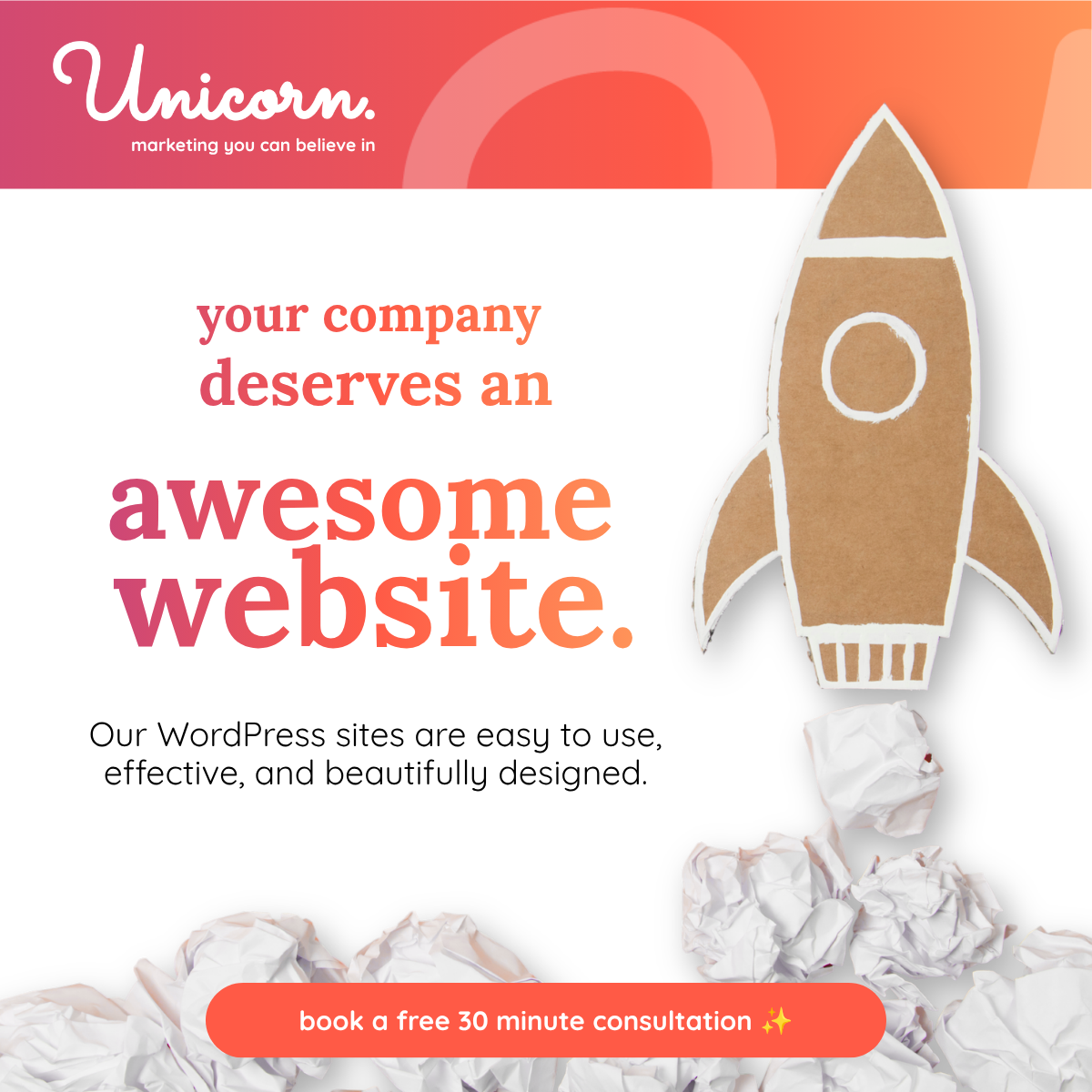
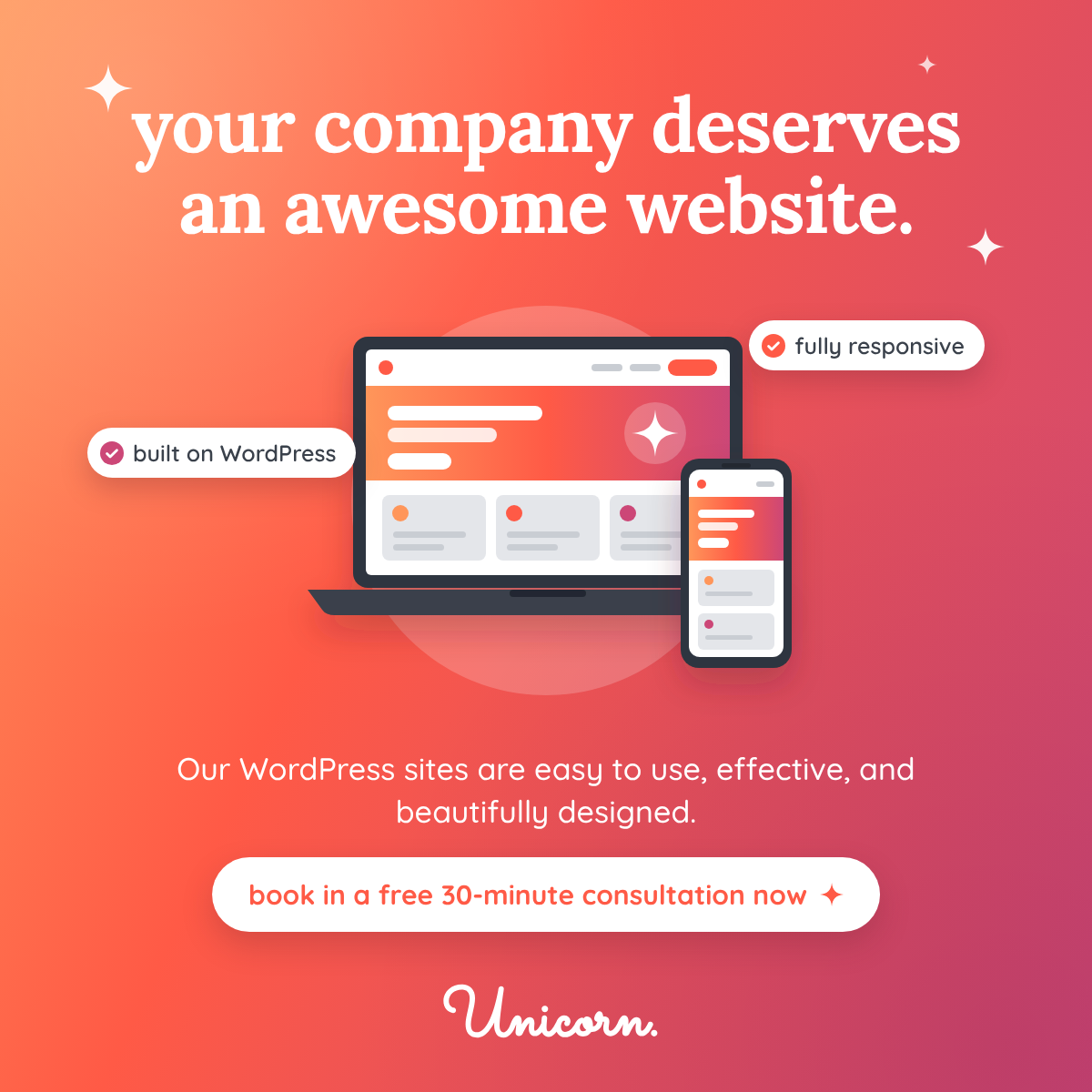
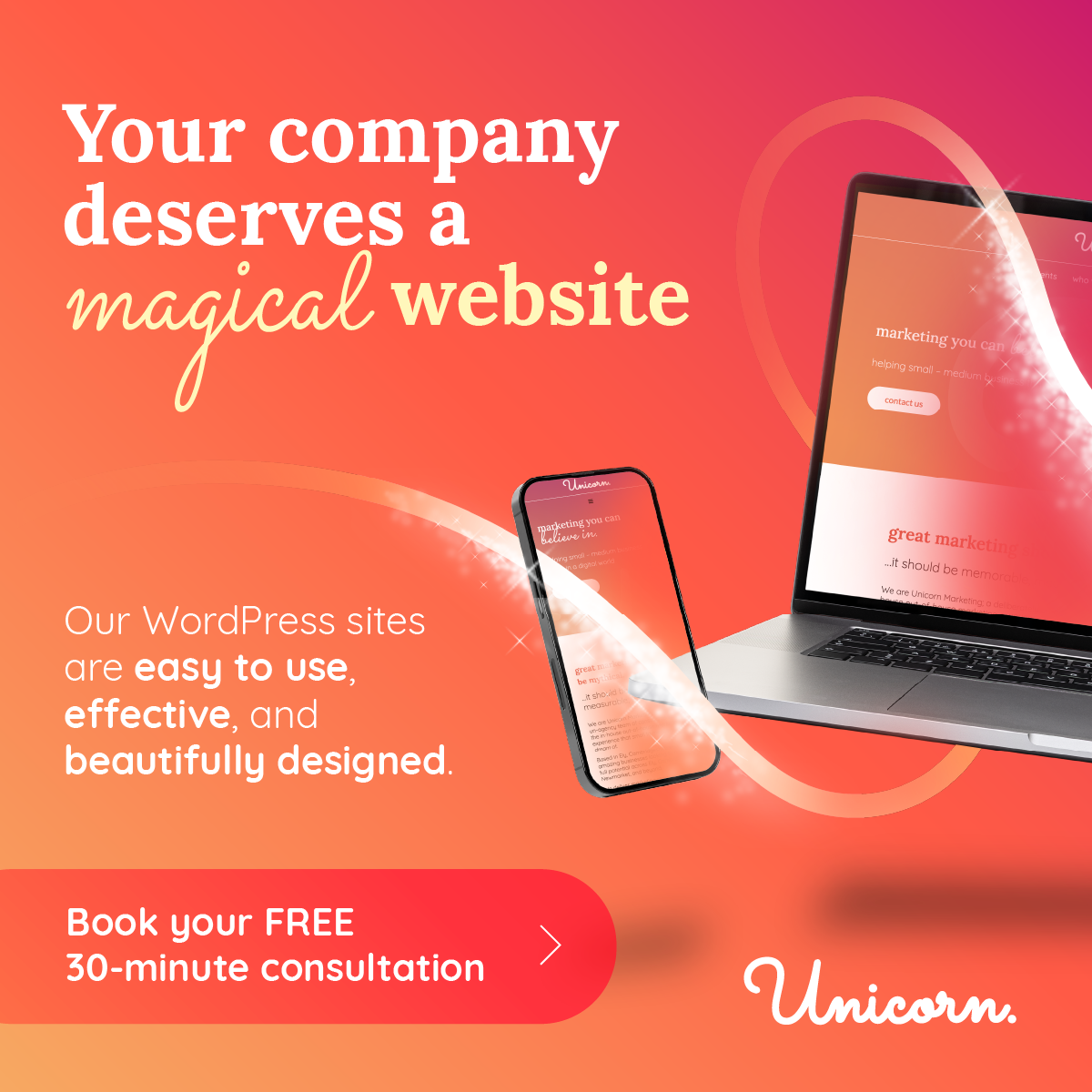
We wrote up a brief to design a graphic advertising our website design services. We passed the same brief to:
- Our Claude (trained in our branding and tone of voice, but not experienced in creating graphics for us)
- One of our team who has reasonable skills in Canva
- And our professional graphic designer with 15+ years experience
Here’s what they came up with. Can you spot the AI, the novice designer, and the professional? (We’ve mixed up the order)
Design 1
|
Design 2
|
Design 3
|
Quick survey:
Follow us on LinkedIn to keep up to date on the results.
ready for graphics that actually work for your business?
At Unicorn Marketing, our team designs pretty much anything your business needs: social graphics, email headers, ads, brochures, presentations, full brand identities, websites and campaign creatives. Every piece is made by experienced people who take the time to understand your business, so it looks right and gets results.
No slop. No random paint swipes in the background. Just design you can be proud to put your name to.
Book your free 30-minute consultation and tell us what you need. We’ll take it from there.

 By Ari

 By Jennifer